Think Forex Support and Resistance Always Work? High-Impact News Can Prove You Wrong!

Abstract:Forex traders often have to come to terms with these two popular concepts - Support and Resistance. A support level refers to the point where buyers have historically come together to prevent the price from sliding further. On the other hand, the point of resistance is where sellers have historically limited upward movement. These two levels form the foundation of many trading strategies employed by traders to spot entry, exit and stop-loss points. However, many beginners begin to think that these price levels are unbreakable. Such assumptions can go horribly wrong during high-impact economic news releases such as inflation reports, employment data, monetary policy announcements by the central bank or any other major news events. These events can trigger price movements so much that even the strongest support and resistance levels can crack within seconds.
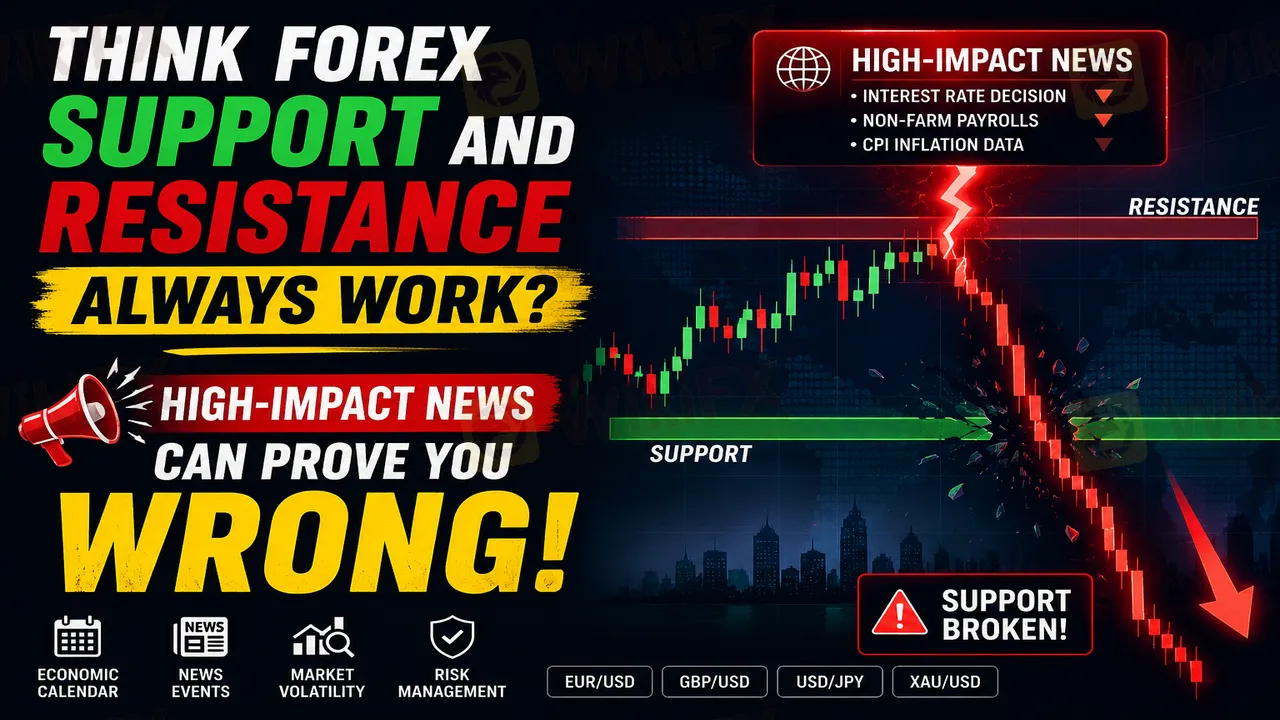
Forex traders often have to come to terms with these two popular concepts - Support and Resistance. A support level refers to the point where buyers have historically come together to prevent the price from sliding further. On the other hand, the point of resistance is where sellers have historically limited upward movement. These two levels form the foundation of many trading strategies employed by traders to spot entry, exit and stop-loss points.
However, many beginners begin to think that these price levels are unbreakable. Such assumptions can go horribly wrong during high-impact economic news releases such as inflation reports, employment data, monetary policy announcements by the central bank or any other major news events. These events can trigger price movements so much that even the strongest support and resistance levels can crack within seconds.
What Makes Support and Resistance Work Most of the Time?
Its the market psychology that makes support and resistance levels exist. Traders often remember the prices where markets reversed previously, creating several buy and sell orders around such levels. Hedge funds, retail traders and institutional traders usually monitor these levels, allowing them to reinforce under normal market conditions.
For instance, if EUR/USD constantly finds buying signals around 1.1500, traders start considering that level as strong support. At the same time, if this currency pair finds it hard to move past 1.1600 many times, it converts into a recognized resistance level. These levels usually lead to temporary reversals or price consolidation under normal market conditions, allowing traders to enter or exit trades.
The Changes Brought by High-Impact News
The fresh information emerging from high-impact news often leads to a change in market expectations. Events, such as the Consumer Price Index (CPI), Non-Farm Payrolls (NFP) and Federal Reserve interest rate decisions or any geopolitical developments, often make traders reassess the currency value almost immediately. These events prevent markets from reacting primarily to historical levels. Rather, the market starts reacting to new economic information.
Suppose the EUR/USD pair has gone beyond a strong support level for several days. If a stronger-than-expected US jobs report significantly raises confidence in the USD, aggressive selling may overwhelm buyers. The previously held support level for multiple times may break with little hesitation. During these times, fundamental developments take precedence rather than technical analysis, for the short term only.
False Signals Due to Increased Volatility
Major news releases come with a sharp rise in market volatility. They may trigger a sudden and sharp price movement within seconds. This will likely make technical signals less reliable. This often leads to false breakouts. Prices may break above resistance for a brief period and then reverse sharply as the initial order wave subsides. At the same time, support may appear broken before buyers quickly regain control. This quick back-and-forth movement usually triggers stop-loss orders on both sides of the market before a clearer direction emerges. Inexperienced traders can make emotional decisions and face unnecessary losses due to these sudden price swings.
Liquidity Can Deplete
High-impact news can lead to reduced market liquidity. Despite increased possibilities of high trading volume, many liquidity providers raise spreads or decrease available liquidity due to increased uncertainty. The likely fewer resting orders around key price levels can easily make relatively large market orders push prices through support or resistance compared to normal trading hours.
So, How Can Traders Protect Themselves During High-Impact News Scenarios?
Technical analysis is as important as fundamental analysis. However, one must understand the limitations major news events can leave you with while trading. You can reduce unnecessary risks by adopting these habits.
- Keep an eye on the economic calendar before opening new positions.
- Check whether high-impact news is for the currency pair you intend to trade.
- Wait until the initial volatility settles before seeking support or resistance for trade entries.
- Cut position sizes during news events if you want to stay in the market.
- Remember to use stop-loss orders and be prepared to face slippage (if any) in a fast-moving market.
Final Thoughts
Support and resistance are powerful tools, but they are not guarantees. During high-impact news events, fresh economic information, heightened volatility, and changing liquidity conditions can quickly overpower historical price levels. Rather than assuming these levels will always hold, traders should treat them as probability zones instead of fixed barriers.
By monitoring the economic calendar, managing position sizes, and combining technical analysis with fundamental awareness, traders can better navigate periods of elevated market volatility and avoid costly surprises when the next major news release hits the Forex market.
Download the WikiFX app for more such insightful forex updates.

Interesting Articles for You
Review 2026: I’m Unable to Receive My Profits. We Investigated This Common User Allegation.
Read more

Centinary Review 2026: I Earned $496,000, but Was I Able to Receive It? Read This Report!
Centinary, a new age broker, has managed to receive quite a bit of user reviews recently. However, all these reviews accuse the broker of robbing users’ funds. From loss of yuan to dollar, traders have been complaining about the alleged hassles faced while withdrawing funds from the Centinary platform. In this Centinary review article, we will take you through the complaints users have made in 2026.
One Lot Size Mistake Can Cost You Thousands—Here's Where the 1% Rule Helps
Switched from one trading strategy to another but could not avert heavy losses? Wondering what went wrong despite your market analysis being spot on? It may not be a strategic issue then. It may just be that you chose the wrong lot size. Yes, a single oversized position can get your account exposed to far greater risks than you may imagine. You may be moved by the impressive profits with increasing lot sizes. But by doing so, you also invite a proportionate rise in losses. This is where you need to apply the essential 1% risk management principle. This rule helps you assess how much you can afford to lose if a trade does not go as planned.

TRANS X MARKETS Review 2026: I Lost as Much as $40K. One of Many Verified User Allegations
This allegation representing fund loss worth $40,000 came from a verified Indian user on a trusted platform such as WikiFX. However, this is not the only allegation from users across India and other regions. Many verified users have complained about the loss of access to withdraw profits from the TRANS X MARKETS platform. At the same time, we came across complaints about the withdrawal issue from the free software provided by the brokerage firm. In this TRANS X MARKETS review, we have examined these allegations while also giving you the company’s regulatory background.
5 Warning Signs Your Forex Account is Heading Toward a Margin Call
New to forex trading? Surprised by the margin call from your forex broker? In one moment, you seem to have manageable trades. The next moment, you receive a warning from your broker about inadequate equity to support your open positions. So, if the market movement continues to be on the opposite side of your positions, some or all of your trades may see an unfortunate automatic closure through a stop-out process. However, margin calls do not usually happen without warning. Recognizing the early signs can help traders take corrective measures and avoid a potentially significant loss in their trading accounts. But what are those signs that indicate that a margin call is all but near? Let’s discuss the same here.
WikiFX Broker
Latest News
Over US$2.9 Million Saved: Singapore's Crypto Scam Crackdown Sends a Warning to Malaysian Investors
WikiFXHow Pig Butchering Scams Drain Beginner Trading Accounts
WikiFXWeltrade Review 2026: Is This Forex Broker Safe?
WikiFXHow Reversal Candlesticks Trap Beginners at the Top and Bottom
WikiFXHTFX Review 2026: Blocked Withdrawals and Severe Risk Signals
WikiFXDollar Navigates Inflation Risks as Oil Prices Spike
WikiFXexfor Review 2026: I’m Unable to Receive My Profits. We Investigated This Common User Allegation.
WikiFXRM5.18 Million Lost: Investment Scams Are Targeting Kelantan
WikiFXTrapping Symmetrical Triangle Breakouts With OCO Pending Orders
WikiFXReview 2026: AximTrade Regulation, Withdrawals, and Platform Risks
WikiFXRate Calc

