Best Lowest Spread Forex Brokers in Indonesia 2026

Abstract:Indonesia's retail forex market has matured into one of Southeast Asia's most active. With more than 800,000 Indonesians now trading currencies online and demand for tighter pricing rising every year, the spread — the gap between a broker's bid and ask quote — has become the single most decisive cost factor for active traders. A difference of even half a pip on EUR/USD can add up to thousands of US dollars annually for a trader running 50+ standard lots a month. This guide breaks down the brokers offering the lowest spreads to Indonesian traders in 2026, explains exactly how spread mathematics impacts your bottom line through real trader scenarios, and walks through the regulatory framework you should understand before depositing.
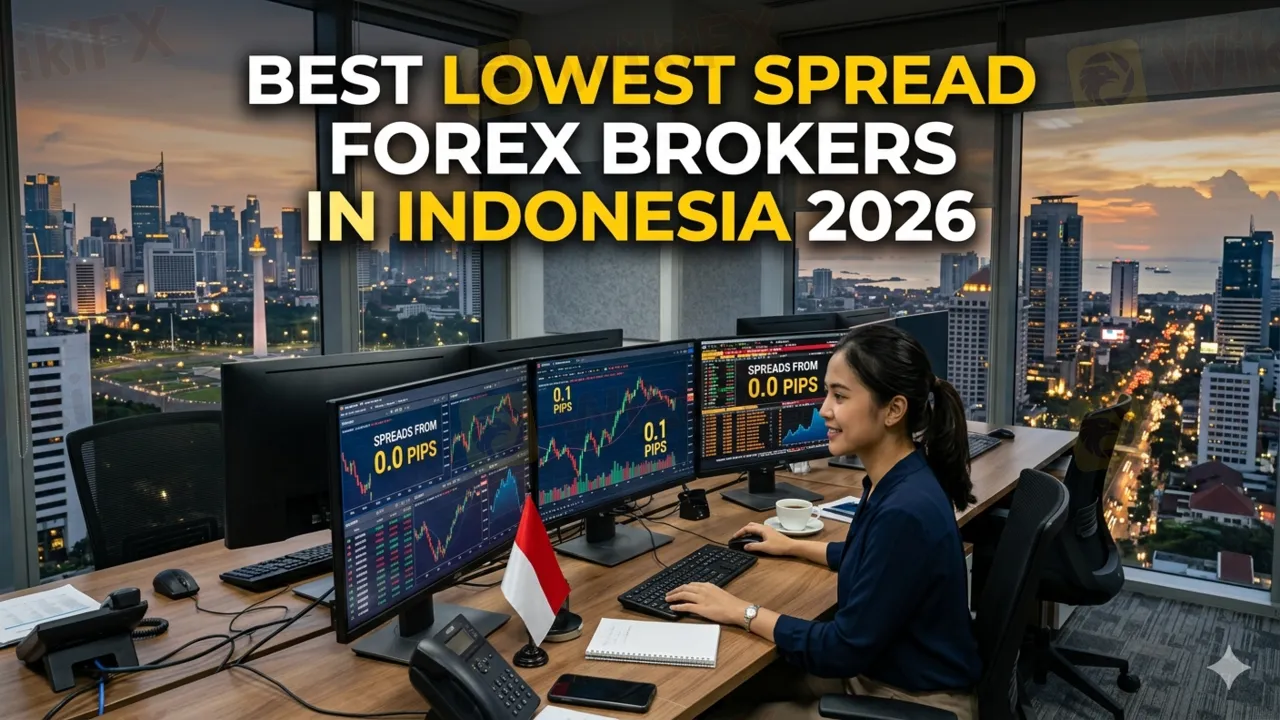
Indonesia's retail forex market has matured into one of Southeast Asia's most active. With more than 800,000 Indonesians now trading currencies online and demand for tighter pricing rising every year, the spread — the gap between a broker's bid and ask quote — has become the single most decisive cost factor for active traders. A difference of even half a pip on EUR/USD can add up to thousands of US dollars annually for a trader running 50+ standard lots a month.
This guide breaks down the brokers offering the lowest spreads to Indonesian traders in 2026, explains exactly how spread mathematics impacts your bottom line through real trader scenarios, and walks through the regulatory framework you should understand before depositing.
Why Spreads Matter More in 2026
The spread is the primary transaction cost in forex trading. When you open a position, you immediately pay this difference, which means a trade has to move in your favor by at least the spread amount before you break even.
Two cost models dominate the Indonesian market in 2026:
- Standard (commission-free) accounts — Spreads typically range from 0.6 to 1.5 pips on EUR/USD. The broker bakes its margin into the spread.
- Raw spread / ECN accounts — Spreads start at 0.0 pips on major pairs, but you pay a fixed commission per lot (usually USD 2.25 to USD 7 round-turn).
For scalpers, day traders, and algorithmic traders, raw-spread accounts almost always work out cheaper. For casual or swing traders placing a handful of trades per week, the difference is less consequential, and a commission-free standard account is often simpler.
But how much does the difference actually cost? That's where the math gets interesting.
The Real Cost of Spread: A Mathematical Breakdown
Spread is often quoted as “0.1 pips” or “1.2 pips” — abstract numbers that don't land emotionally until you translate them into dollars. The actual cost depends on three variables: how wide the spread is, how big your trades are, and how often you trade.
Here's the foundation. On EUR/USD:
- 1 pip on 1 standard lot (100,000 units) = USD 10
- 1 pip on 1 mini lot (10,000 units) = USD 1
- 1 pip on 1 micro lot (1,000 units) = USD 0.10
That's the unit cost. Multiply by your monthly volume and you have your annual spread bill. Let's run through three trader profiles to see what this looks like in practice.
Scenario A: Andi the Swing Trader
- Account size: USD 2,000
- Trades per month: ~8 (holds positions 2–5 days)
- Monthly volume: 5 standard lots of EUR/USD
Standard account (1.2 pip spread, no commission): 5 lots × USD 12 = USD 60/month = USD 720/year
Raw spread account (0.1 pip + USD 7 round-turn commission): 5 lots × USD 8 = USD 40/month = USD 480/year
Annual savings on ECN: USD 240 (33% lower)
For Andi, the savings are real but not life-changing. At this volume, simplicity often matters more than squeezing out the lowest absolute cost. A standard account with native Bahasa Indonesia support may serve him better than a complex commission structure.
Scenario B: Budi the Day Trader
- Account size: USD 5,000
- Trades per month: ~50 (intraday positions)
- Monthly volume: 50 standard lots of EUR/USD
Standard account: 50 × USD 12 = USD 600/month = USD 7,200/year
Raw spread account: 50 × USD 8 = USD 400/month = USD 4,800/year
Annual savings on ECN: USD 2,400
That USD 2,400 represents almost half of Budi's starting capital — purely from broker selection. At this volume, the broker choice stops being a preference and becomes a strategic decision that directly affects net profitability.
Scenario C: Citra the Scalper
- Account size: USD 20,000
- Trades per month: ~400 (positions held seconds to minutes)
- Monthly volume: 200 standard lots of EUR/USD
Standard account: 200 × USD 12 = USD 2,400/month = USD 28,800/year
Raw spread account: 200 × USD 8 = USD 1,600/month = USD 19,200/year
Annual savings on ECN: USD 9,600
For a high-volume scalper, spread cost is a make-or-break factor. A strategy generating USD 30,000/year on an ECN account might net only USD 20,400 on a standard account — a 32% drop in net performance attributable purely to execution cost, before any trading skill is considered.
What About Tiny Differences Between Two ECN Brokers?
Even between two raw-spread brokers, the gap matters at scale:
- Broker X: 0.2 pip raw + USD 6 round-turn = USD 8/lot
- Broker Y: 0.5 pip raw + USD 7 round-turn = USD 12/lot
USD 4 per lot sounds trivial. At 200 lots/month, that's USD 800/month = USD 9,600/year. Identical to the standard-vs-ECN difference Budi sees at his volume.
Spreads Widen — Sometimes Dramatically
The numbers above assume normal market conditions. During major news releases (US Non-Farm Payrolls, FOMC announcements, ECB decisions), spreads can widen 5–20x for 30–120 seconds:
- EUR/USD: typically 0.1 pip → 1.5–3.0 pips
- XAU/USD (gold): typically 1.5 pips → 15–40 pips
- GBP/JPY: typically 1.5 pips → 8–20 pips
A scalper hitting “Buy” 0.5 seconds before NFP can pay 30x the normal spread on a single trade. This is why most professional traders avoid market orders during scheduled high-impact news — using pending limit orders or simply staying flat.
The Takeaway
The math says three things clearly:
- Volume drives the decision. Below ~10 lots/month, the broker choice barely matters. Above ~50 lots/month, it can swing thousands of dollars annually.
- Small spread differences compound. A 0.3-pip gap × 200 monthly lots = USD 600/month — bigger than most people's monthly grocery bill.
- Average spreads lie. A broker advertising “0.1 pip average” may widen to 3 pips during the times you most want to trade (news, market open). Test execution during volatile periods, not just quiet ones.
Top Lowest-Spread Forex Brokers for Indonesia in 2026
The brokers below are ranked by all-in trading cost (raw spread plus commission) on EUR/USD, cross-referenced against execution quality, regulation, and the availability of Indonesian-friendly funding methods such as BCA, Mandiri, BRI, BNI, OVO, GoPay, DANA, and QRIS.
1. Fusion Markets — Lowest All-In Cost
Fusion Markets, based in Melbourne and regulated by ASIC, VFSC (Vanuatu), and the Seychelles FSA, has built its reputation on aggressive pricing. On its Zero Account, EUR/USD averages around 0.02–0.11 pips with a commission of just USD 2.25 per side (USD 4.50 round-turn). That puts the all-in cost near USD 5.50 per standard lot — roughly 25–30% cheaper than most competitors.
- EUR/USD raw spread: 0.02–0.11 pips
- Commission: USD 4.50 round-turn per lot
- Minimum deposit: None (payment-processor minimums apply)
- Platforms: MT4, MT5, cTrader, TradingView
- Local funding in Indonesia: Yes (local bank transfer supported)
Trade-offs: educational content is thin, and overnight swap rates run higher than average, which matters if you hold positions for days.
2. IC Markets — Tightest Raw Spreads
IC Markets, founded in 2007 and regulated by ASIC and CySEC, consistently posts the tightest raw spreads in independent testing. On the cTrader Raw account, the average EUR/USD spread sits near 0.02 pips, with commission of USD 3 per side (USD 6 round-turn). On MT4/MT5 Raw, commission is USD 3.50 per side.
- EUR/USD raw spread: ~0.02–0.1 pips
- Commission: USD 6–7 round-turn per lot
- Minimum deposit: USD 200
- Platforms: MT4, MT5, cTrader
- Execution: Sub-40ms with deep liquidity from 25+ providers
Best for scalpers, algo traders, and anyone running EAs that depend on minimal slippage.
3. Pepperstone — Best Regulation + Tight Pricing
Pepperstone is regulated by five Tier-1 authorities (ASIC, FCA, CySEC, BaFin, DFSA), making it one of the most heavily supervised brokers Indonesian traders can access. Its Razor account offers EUR/USD spreads averaging around 0.1 pips with a USD 3.50 per-side commission.
- EUR/USD raw spread: ~0.1 pips
- Commission: USD 7 round-turn per lot
- Minimum deposit: USD 0
- Platforms: MT4, MT5, cTrader, TradingView, Pepperstone proprietary
- Notable: Capitalise AI for code-free algorithmic strategies; free deposits and withdrawals
If you prioritize regulatory depth and platform variety over absolute lowest cost, Pepperstone is hard to beat.
4. FP Markets — Strong on Cross Pairs
FP Markets, regulated by ASIC and CySEC, runs a Raw account with spreads from 0.0 pips and a USD 3 per-side commission. It tends to outperform competitors on minor and cross pairs where many ECN brokers widen significantly.
- EUR/USD raw spread: 0.0–0.1 pips
- Commission: USD 6 round-turn per lot
- Minimum deposit: USD 100
- Platforms: MT4, MT5, cTrader, TradingView
- Notable: Segregated funds in AA-rated banks, NY4 server execution around 20ms
5. Exness — Best Local Payment Integration
Exness isn't BAPPEBTI-licensed but is regulated globally by the FCA, CySEC, FSCA, FSA Seychelles, and CMA Kenya. For Indonesian traders, it stands out for one reason: full local payment integration. Deposits and withdrawals work in IDR through BCA, Mandiri, BRI, BNI, CIMB Niaga, OVO, DANA, GoPay, ShopeePay, and QRIS — typically processed in seconds for e-wallets and within hours for bank transfers.
- EUR/USD raw spread: From 0.0 pips on Raw Spread and Zero accounts
- Commission: From USD 0.05 per lot per side on Zero account
- Minimum deposit: Around IDR 150,000 (~USD 10) for Standard
- Maximum leverage: Up to 1:2000 (unlimited under certain equity conditions)
- Platforms: MT4, MT5, Exness Terminal, Exness Trade App
- Notable: Automatic swap-free for Indonesian residents (Sharia-compliant)
6. XM — Best Local Onboarding for Beginners
XM, regulated by CySEC, ASIC, FSC Belize, FSCA, and DFSA, is the most prominent international broker offering full GoPay, OVO, DANA, LinkAja, and ShopeePay support. Its Ultra Low account narrows EUR/USD spreads to around 0.6 pips with no commission.
- EUR/USD spread: From 0.6 pips on Ultra Low (no commission)
- Minimum deposit: USD 5
- Platforms: MT4, MT5
- Notable: Extensive Bahasa Indonesia education, webinars, and customer support; Islamic accounts
XM is particularly suited to traders who want a simple commission-free model, native-language education, and broad local funding without diving into ECN pricing complexity.
7. Tickmill — Low Commissions for Cost-Conscious Traders
Tickmill is regulated by the FCA, CySEC, FSA Seychelles, Labuan FSA, and FSCA. Its Pro account offers raw spreads with one of the lowest commission structures in the industry.
- EUR/USD raw spread: From 0.0 pips
- Commission: USD 4 round-turn per lot on Pro account
- Minimum deposit: USD 100
- Platforms: MT4, MT5
8. BlackBull Markets — High-End ECN Access
Regulated by the New Zealand FMA and the Seychelles FSA, BlackBull's ECN Prime account offers EUR/USD spreads from 0.0 pips. The broker supports MT4, MT5, cTrader, TradingView, and its own BlackBull App, with a USD 0 minimum deposit on entry-level accounts.
9. Hantec Markets — Solid Mid-Tier Option
Multi-regulated (FCA, FSCA, FSC Mauritius, ASIC), Hantec offers Raw ECN spreads from 0.0 pips on EUR/USD and a USD 10 minimum deposit. Standard account spreads average around 1.2 pips.
10. OctaFX (Octa Investama Berjangka) — Top BAPPEBTI-Licensed Choice
For traders who specifically want the protection of a local license, OctaFX operates through PT Octa Investama Berjangka, which is BAPPEBTI-regulated. Spreads on its standard account start near 0.6 pips on EUR/USD with no commission. Other notable BAPPEBTI-licensed brokers include Monex Investindo Futures, Valbury Asia Futures, HFX (Hanson Forex Join), GKInvest, Agrodana, and Trive Invest.
The trade-off with BAPPEBTI-only brokers: leverage is capped at 1:100, and pricing is typically wider than what offshore ECN brokers offer.
Spread Comparison at a Glance
[Comparison table renders separately in the publishing system]
Spread figures are averages from broker disclosures and third-party testing in Q1–Q2 2026. Actual spreads vary with market conditions and may widen significantly during news events and outside peak liquidity hours (the London–New York overlap of roughly 19:30–22:00 WIB).
The Indonesian Regulatory Landscape
Before picking a broker from the list above, every trader needs to understand the regulatory framework that governs forex trading in Indonesia — because where a broker is licensed determines what protections you actually have if something goes wrong.
BAPPEBTI
BAPPEBTI (Badan Pengawas Perdagangan Berjangka Komoditi), under the Ministry of Trade, is the primary regulator for forex and commodity derivatives. Established in 1997 and significantly strengthened after 2013, BAPPEBTI enforces the following on licensed brokers:
- Client funds must be held in segregated accounts at approved clearing houses (KBI or ICH).
- Maximum leverage is capped at 1:100.
- Brokers must provide transparent dispute-resolution procedures.
- Sharia-compliant (swap-free) options must be available given Indonesia's Muslim-majority demographics.
Verifying a broker's BAPPEBTI license is straightforward: visit bappebti.go.id and search the company name in the “Pialang Berjangka” (Futures Broker) registry.
OJK and Bank Indonesia
The Otoritas Jasa Keuangan (OJK) supervises broader financial services and digital-asset oversight, while Bank Indonesia handles rupiah and FX policy. Neither directly licenses retail forex CFD brokers, but both play a supporting role in consumer protection.
Local vs International Brokers
Because BAPPEBTI restricts leverage and applies relatively heavy compliance costs, locally licensed brokers tend to offer wider spreads (typically 1.0–3.0 pips on EUR/USD) than their international counterparts. As a result, a large share of Indonesian retail traders use offshore brokers regulated by top-tier authorities such as the FCA (UK), ASIC (Australia), CySEC (Cyprus), or BaFin (Germany). This is legally tolerated, but you should know that disputes with offshore entities fall outside Indonesian jurisdiction.
In May 2025, Plus500 acquired a BAPPEBTI-licensed Indonesian broker — a notable signal that international firms increasingly see value in obtaining a local footprint rather than relying purely on offshore onboarding.
How to Choose the Right Broker
Spread alone shouldn't drive the decision. The strongest combination of factors for Indonesian traders in 2026 looks like this:
Regulation. A Tier-1 regulator (FCA, ASIC, CySEC, BaFin) plus optional BAPPEBTI licensing gives the best of both worlds. Verify license numbers directly on the regulator's official register, not the broker's marketing pages.
Local funding. If you want to deposit and withdraw in rupiah without conversion friction, prioritize brokers with native support for BCA, Mandiri, BRI, BNI, plus e-wallets like OVO, GoPay, DANA, and ShopeePay. Exness, XM, and OctaFX lead in this category.
Islamic / swap-free accounts. Around 87% of Indonesia is Muslim, and Sharia-compliant trading means no overnight interest charges. Most reputable brokers offer this, but some apply alternative administration fees — always read the fine print.
Platform fit. MT4 remains the de facto standard for EA-based and copy trading. MT5 adds more timeframes and instruments. cTrader is preferred by scalpers and algo traders for its depth-of-market view and lower slippage. TradingView integration is increasingly common.
Customer support in Bahasa Indonesia. This matters more than most traders expect. When a withdrawal stalls or a position closes unexpectedly, having native-language support drastically shortens resolution time.
Execution quality. Tight spreads mean little if orders slip on entry. Look for brokers publishing average execution speed (sub-100ms is competitive; sub-40ms is excellent) and slippage statistics from independent testing.
Risk Disclosure
Forex and CFD trading carries substantial risk. Most retail trader accounts lose money — broker-published figures typically place this between 65% and 89%. Leverage amplifies both gains and losses, and a relatively small adverse price move can wipe out an entire account on a highly leveraged position.
This article is informational and does not constitute investment, legal, or financial advice. Before opening any live account, verify the broker's regulatory status independently, read the client agreement in full, and consider whether forex trading aligns with your financial situation, knowledge, and risk tolerance. If you're unsure, consult a licensed financial professional in Indonesia.
Bottom Line
For 2026, Fusion Markets offers the lowest all-in cost on EUR/USD for Indonesian traders, with IC Markets and FP Markets close behind on raw-spread pricing and Pepperstone leading on regulatory depth. For traders who prize fast IDR funding and local payment integration, Exness and XM remain the most convenient international options. For those who specifically want BAPPEBTI protection, OctaFX (Octa Investama Berjangka) and Monex Investindo Futures are the most credible local choices, accepting that their spreads will be wider and leverage capped at 1:100.
Whichever broker you pick, run the math on your own volume first — the difference between the right and wrong choice could be a few hundred dollars or tens of thousands per year, depending on your scale. Open a demo account, test execution under your typical trading conditions, and verify the license on the official regulator's website before depositing real funds.
To know more insightful forex updates, download the WikiFX app today.

More Insightful Articles for You

Read more
ALFX Review 2026: Fast Withdrawals, Easy Deposits—Reality or Hype?
ALFX, a new-age brokerage firm with around two years of service track record, seemed to have recorded around 30 reviews by users worldwide, including those in India. While some question the deposit & withdrawal process based on their poor experience, some appreciate its smooth payment services and impressive spreads. This ALFX review article takes both positive and negative user feedback for the broker. This will allow you to make an informed financial decision.
$100 Million Fine, Deposit Delays and Customer Outrage: Is TIGER BROKERS Losing Traders' Trust?
Contemplating trading via Tiger Brokers, a Hong Kong-based forex broker? Be aware that the brokerage firm was recently fined $100 million or more by the Chinese Securities Regulatory Commission (CSRC) for illegal activities. The news broke on June 8, 2026. While we will discuss this incident separately, the brokerage firm is not free from user allegations on issues concerning deposits, withdrawals and customer support service. On most customer service parameters (deposit safety & trading), Tiger Brokers is found to be ranking lower. In this Tiger Brokers review, we have investigated the brokerage firm, its trade offerings, recent regulatory action, a plethora of user allegations, and its regulatory background. Let’s start investigating.
WAYONE CAPITAL Review 2026: Trading Complaints on Withdrawal Denials & Platform Glitches
WAYONE CAPITAL, a Saint Lucia-based forex broker, is reportedly facing allegations from users worldwide. Most users allege that the brokerage entity does not comply with fund withdrawal norms and gives petty excuses for not releasing funds on time. Additionally, users have complained about the reflection of the wrong trading account balance while accessing the WAYONE CAPITAL login. If you have faced similar concerns with this broker, you are at the right place! This 2026 WAYONE CAPITAL review article examines user allegations and gives an update on the broker’s regulatory status.

Lost Your Capital by Clicking on a Forex Trading Link? This is the Latest Scam Trend!
Newspaper after newspaper, social media platforms after social media platforms, we often come across the term forex trading scam. It’s taking a vicious shape. Unknown profiles constantly jam your phones or social media accounts with luring messages of guaranteed and astonishing returns that you may not have heard of before. So, what many do? They click on the link and get into a dreamy, yet fake world that somehow appears much later. More so, in many cases, after the scam. The case of XPO.ru last year, where users were told to click on a link to start forex trading, led to the siphoning of as much as INR 3,100 crore, leaving affected investors and the authorities puzzling over the incident. While the XPO scam was a massive incident, there has not been a shortage of these incidents. The Internet is flooded with stories concerning forex scams of this nature. In this article, we take a close look at several such scams.
WikiFX Broker
Latest News
Spotting Trend Reversals: How to Read Hammer and Engulfing Candlesticks
WikiFXWhy Real Money Forex Trades Trigger Early Exits
WikiFXRM371,000 in Life Savings Lost After Trusting a Facebook Investment Ad
WikiFX$100 Million Fine, Deposit Delays and Customer Outrage: Is TIGER BROKERS Losing Traders' Trust?
WikiFXStockity Review 2026: Offshore Regulation, Complaints, and Withdrawal Risk Signals
WikiFXJapan raises interest rate to highest since 1995
WikiFXTrading the 24-Hour Currency Market on a 9-to-5 Schedule
WikiFXDollar Slips After Ceasefire Agreement
WikiFXForexDana Review 2026: Is This Forex Broker Safe?
WikiFXKraken Becomes FIFA World Cup 2026's Official Crypto Exchange | What It Means for Investors
WikiFXRate Calc

