Understanding Dbinvesting Deposit and Withdrawal: What Traders Should Know

Abstract:When choosing a forex broker, few things matter more than how easy it is to make investments and withdraw them. Looking into the Dbinvesting Deposit and Dbinvesting Withdrawal processes is an important part of researching this broker. At first glance, this broker offers normal payment options. However, many users have reported serious problems that show a big difference between what the company promises and what actually happens to real traders. This article aims to give you the complete, honest truth. We will look at both the official procedures that Dbinvesting advertises and the real risks that every trader needs to know about. Here's some important background: as of early 2026, WikiFX (a global financial review website) gives Dbinvesting a very low score of 2.14 out of 10 and warns users to "Low score, please stay away!" This creates a dangerous situation where traders need to be extremely careful. This guide will first explain the payment methods the company claims to offer, then
When choosing a forex broker, few things matter more than how easy it is to make investments and withdraw them. Looking into the Dbinvesting Deposit and Dbinvesting Withdrawal processes is an important part of researching this broker. At first glance, this broker offers normal payment options. However, many users have reported serious problems that show a big difference between what the company promises and what actually happens to real traders. This article aims to give you the complete, honest truth.
We will look at both the official procedures that Dbinvesting advertises and the real risks that every trader needs to know about. Here's some important background: as of early 2026, WikiFX (a global financial review website) gives Dbinvesting a very low score of 2.14 out of 10 and warns users to “Low score, please stay away!” This creates a dangerous situation where traders need to be extremely careful. This guide will first explain the payment methods the company claims to offer, then look closely at the serious complaints about withdrawals. Before you continue reading, we strongly suggest checking the current information and user reports on Dbinvesting's WikiFX page to get the latest updates.
Dbinvesting's Official Payment System
How to Add and Withdraw Funds
To answer questions about Dbinvesting's payment systems, we need to first look at what the broker officially says it offers. The company advertises several different methods for customers globally, claiming fast processing and no fees for deposits. This information gives us a starting point to compare with the real user experiences we'll discuss later.
The table below shows the main details of its deposit system as the broker presents it publicly. This makes it easy to see and understand the options available to traders when adding funds to an account.
| Method | Type | Regions Served | Processing Time (Deposits) | Stated Fees (Deposits) | Minimum Deposit |
| VISA/Mastercard | Card Payment | Asia, Africa, Latam, MENA | Instant | None | $100 (or EUR/GBP equiv.) |
| SWIFT | Bank Transfer | Asia, Africa, Latam, MENA | 1-3 Working Days | None | $100 (or EUR/GBP equiv.) |
| SEPA | Bank Transfer | Asia, Africa, Latam, MENA | 1-3 Working Days | None | $100 (or EUR/GBP equiv.) |
| Perfect Money | E-Wallet | Asia, Africa, Latam, MENA | Instant | None | $100 (or EUR/GBP equiv.) |
| Jeton | E-Wallet | Asia, Africa, Latam, MENA | Instant | None | $100 (or EUR/GBP equiv.) |
| Fasa Pay | E-Wallet | Asia, Africa, Latam, MENA | Instant | None | $100 (or EUR/GBP equiv.) |
Main Points About Its Rules
Based on the official information, Dbinvesting's payment system looks good on paper. Here are the key points from what they claim:
· Many Different Methods: The broker supports several types of payments, including major credit cards, international and European bank transfers, and popular digital wallets. This shows it is trying to serve many different types of customers.
· No Fees Claimed: Dbinvesting says it doesn't charge any fees for deposits made through these methods. This sounds attractive for traders who want to use all their funds for trading.
· Easy to Start: With a minimum deposit of $100 for most accounts, it's not too expensive to begin, making it accessible for new or small traders.
· Missing Important Information: There's a big problem here. The available information doesn't clearly explain withdrawal processing times, possible fees, or any special conditions for withdrawing funds. For any trader, understanding how to withdraw funds is just as important as knowing how to put them *in*. This lack of clear information is a major warning sign.
The Truth About Dbinvesting Withdrawals
A Clear Pattern of Problems
While the official deposit process seems simple, the reality of Dbinvesting withdrawals, as reported by many users, tells a very different and worrying story. This is where the main danger lies. WikiFX has received and recorded multiple user complaints against this broker, with one clear and repeated problem: “reports of being unable to withdraw and scams.”
A consistent pattern shows up in these detailed user reports:
· What Happens: Traders invest basically due to the lure of seemingly attractive bonus offers. They start trading, sometimes losing capital and adding more, but eventually making good profits through successful trading strategies.
· The Problem: When the trader tries to withdraw, especially amounts that include profits, the process stops working. Requests are either ignored, delayed forever, or simply rejected.
· The Excuses: The broker supposedly gives unclear and unproven reasons for blocking the withdrawal. Common excuses mentioned in complaints include “bonus abuse,” “scalping,” “swap abuse,” or needing an “AML review,” often without providing any real proof of wrongdoing.
· The Result: In the worst cases, the user's profits are completely removed from their trading account. Some reports say that their entire account balance was set to zero, or their account was closed without returning the funds. The main problem is always the same: profits are supposedly taken away.
Real Examples from Reports
To show these patterns, we have summarized several detailed complaints filed by traders. These anonymous case studies give a firsthand look at the risks involved.
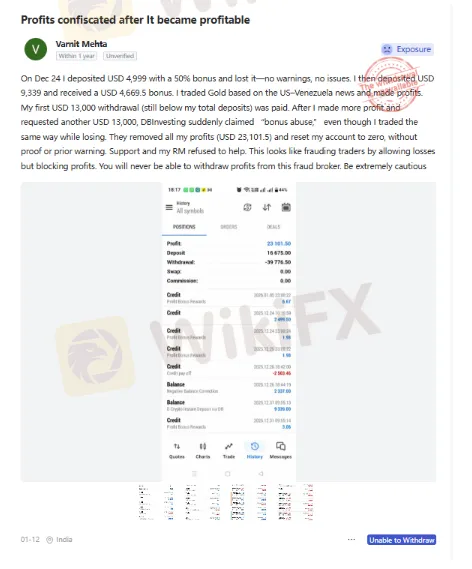
Case Study 1: Profits Deleted After Successful Trading
One user reported investing $4999 initially, which was lost in trading. They then deposited another $9,339. After a successful trading period, the user's account grew a lot. A first withdrawal request for $13,000 was processed, which was still less than their total deposits. However, after making more profit, a second withdrawal request was made. At this point, the broker supposedly claimed “bonus abuse,” even though the user said they traded the same way when they were losing money. The result was the complete removal of $23,101.5 in profits from the account, basically resetting it to zero without warning or real proof of any rule violation.
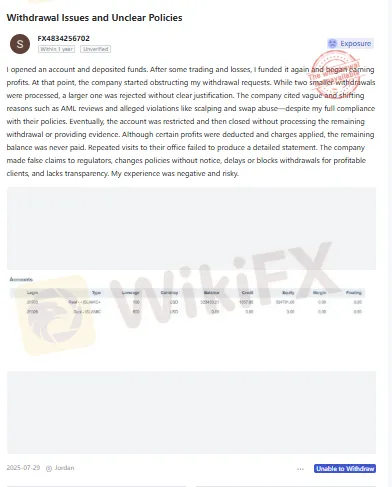
Case Study 2: Blocking and Unfair Penalties
Another trader described a similar experience: depositing funds, trading, and eventually becoming profitable. Once profits were made, withdrawal requests were met with resistance. The broker supposedly gave a changing series of reasons for rejection, moving from AML reviews to accusations of scalping and swap abuse, all of which the user denied. The situation got worse until the broker reportedly closed the account entirely, refusing to process the remaining balance and failing to provide a detailed statement to justify their actions.
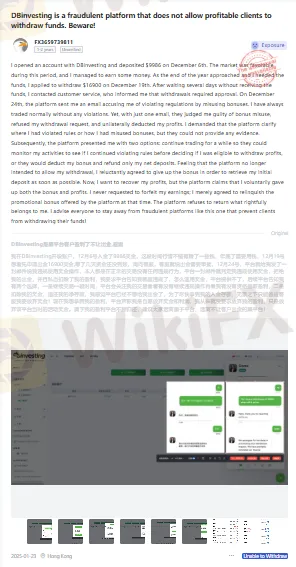
Case Study 3: The “Voluntary” Give-Up Trick
A third detailed report involved a trader who deposited nearly $10,000 and earned significant profits. When they tried to withdraw $16,900, the request was blocked with an accusation of bonus misuse. The broker then supposedly gave the trader two choices: either continue trading under a period of “observation” to see if more violations occurred, or have only the initial deposit returned, giving up all profits. Feeling trapped and seeing no other way to get their original money back, the user felt forced to “agree” to give up the profits just to get their original investment back. The broker later claimed the user voluntarily gave up their earnings.
These summaries represent only a small part of the detail provided by the users. We encourage traders to read the full, firsthand accounts on the Dbinvesting exposure section on WikiFX to understand the complete picture of these risks.
Understanding the Root Risk Factors
The repeated withdrawal problems reported by users don't happen by accident. They are often connected to basic weaknesses in a broker's regulation and operations. Understanding these warning signs is essential for any trader to make safer decisions.
The Seychelles FSA Regulation
Dbinvesting is run by DB Invest LIMITED, a company regulated by the Seychelles Financial Services Authority (FSA) with license number SD053. It's important for traders to understand what this means for the safety of their money.
The Seychelles FSA is considered an offshore regulator. While it gives an appearance of legitimacy, the level of protection it offers is much weaker than that of top-level regulatory bodies. A simple comparison shows the difference:
· Top-Level Regulators: Authorities, such as the Financial Conduct Authority (FCA) in the UK or the Australian Securities and Investments Commission (ASIC), require strict rules for brokers. These include high minimum money reserves, mandatory separation of client funds from company funds, and participation in investor protection programs (such as the FSCS in the UK) that can protect a trader's capital up to a certain limit if the broker goes out of business.
· Offshore Regulators: Regulators, such as the Seychelles FSA, typically have much lower capital requirements, less strict oversight, and rarely offer any form of investor protection fund. If there's a dispute—such as a refused withdrawal—a trader has very limited legal options, and solving the problem becomes extremely difficult and expensive.
Breaking Down Warning Signs
Beyond the weak regulatory oversight, several other warning signs from the Dbinvesting profile on WikiFX create a concerning picture.
· A 2.14/10 Score: On a comprehensive rating platform that analyzes dozens of factors, such a low score is a significant warning. It's not a random number; it reflects a poor evaluation across licensing, business practices, risk management, software, and regulatory measures.
· “High potential risk” Label: This is a direct tag applied by the reviewing platform. It serves as a clear, simple warning that dealing with this broker carries a higher level of risk compared to the industry average.
· Confirmed “No Physical Presence”: Perhaps one of the most serious red flags is the result of on-site investigations conducted by WikiFX. Investigators who visited the broker's listed business addresses in Cyprus and Egypt found that Dbinvesting had no physical presence at these locations. A legitimate financial services company should have a real, verifiable physical operation. The absence of one raises serious questions about the firm's honesty, accountability and overall legitimacy.
A Careful Final Judgment on Payments
In conclusion, a deep look into Dbinvesting's deposit and withdrawal processes shows a critical disconnect. On paper, the broker's official deposit system appears normal, offering multiple methods and a low entry barrier. However, the wealth of detailed, consistent, and severe user complaints paints a dangerously different picture. The evidence strongly suggests that the main problem is not with investing funds, but with getting them *out*.
The repeated theme of profitable accounts being blocked from making withdrawals, combined with the taking of earnings under unclear and unproven accusations, is a pattern that cannot be ignored. These reports are made worse by structural red flags, including weak offshore regulation that offers minimal protection and the confirmed lack of a physical presence at its listed offices.
Based on this evidence, the final practical advice must be of extreme caution. The risk-reward balance appears heavily weighted against the trader. While the potential for trading profits exists with any broker, at Dbinvesting, that potential is overshadowed by the documented risk that those profits may never reach your bank account. We strongly advise against depositing funds with this broker, especially for any trader who cannot afford the devastating risk of losing not only their trading profits but potentially their entire investment.
The decision to invest is ultimately personal, but it must be informed. We strongly advise every potential trader to visit the official Dbinvesting page on WikiFX. Review the license details, the live score, and every single user complaint before considering sending any funds to this broker.
Update - Improve your broker regulation inquiry experience with our new WikiFX app that showcases more effective broker comparison and rankings. Start downloading it by scanning this QR code below.

Read more
Dbinvesting User Reputation: Is It a Safe Broker or a Scam?
When checking for a broker, the most important question is always about safety. Is my capital secure? Can I take out my profits? For Dbinvesting, the evidence we have gathered points to a conclusion that should make any trader think twice. Based on a thorough review of user feedback, regulatory status, and how transparent they are, Dbinvesting presents a high potential risk to its clients. We don't make this claim lightly; it's based on facts we can verify and a clear pattern of user-reported problems that can't be ignored.
Dbinvesting Regulation: A Complete Guide to Its License and High-Risk Status
When looking at a broker, the first question is always about safety. Is Dbinvesting a safe platform for your investments? The immediate answer is complicated and requires extreme caution. While Dbinvesting is officially a regulated company, its license comes from the Seychelles Financial Services Authority (FSA), which is classified as an offshore regulator. This difference is important and forms the basis of the high-risk status connected to this broker. This initial concern is made worse by objective, third-party data. As of our 2026 review, Dbinvesting holds an extremely low WikiFX safety score of just 2.14 out of 10. This score is not random; it is a data-based reflection of the broker's weak regulation, lack of transparency, and most importantly, its track record with clients. The platform has been flagged for a large number of serious user complaints, which show a disturbing pattern of issues, especially concerning withdrawing funds and the random cancellation of profits. The pu
Evest Broker Review: Regulated, but Complaints Persist
Evest is regulated, yet exposure reports cite withdrawal issues and aggressive managers. Verify the license on the WikiFX App before you deposit.
4T Broker Review: Regulation, Risks & Scam Alerts
Is 4T a safe forex broker? Learn how FCA and offshore licenses work, the risks traders face, and how the WikiFX App helps you avoid 4T scams before investing.
WikiFX Broker
Latest News
CySEC Withdraws CIF License of OBR Investments Ltd (OBRInvest)
WikiFXRM115 Million Lost in a Month: Are Malaysians Underestimating Investment Scams?
WikiFXInvest RM300, Make RM10,000? Police Say It’s a Scam
WikiFXXBTFX Review: Beware of Offshore Regulated Forex Traps
WikiFXFX Markets: King Dollar Reigns Amid Chaos; BoJ Eyes "Neutral" Rates
WikiFXWar in the Middle East: Oil Spikes and Stocks Tumble as Conflict Enters "Uncharted Territory"
WikiFXGeopolitical Conflict Drives Gold Rally as Insurers Cut Gulf Coverage
WikiFXMiddle East Tensions Rattle Risk Sentiment: Airspace Closures Signal Supply Fears
WikiFXOil Markets Rally as Escalating Middle East Conflict Threatens Supply Lines
WikiFXInvestment Scams That Could Be Targeting Malaysians Right Now
WikiFXRate Calc
