Voices of the Golden Insight Award Jury | Kathy Lien, Co-Founder of BKTraders & PropTraderEdge.com

Abstract:WikiFX Golden Insight Award uniting industry forces to build a safe and healthy forex ecosystem, driving industry innovation and sustainable development, launches a new feature series — “Voices of the Golden Insight Awards Jury.” Through in-depth conversations with distinguished judges, this series explores the evolving landscape of the forex industry and the shared mission to promote innovation, ethics, and sustainability.
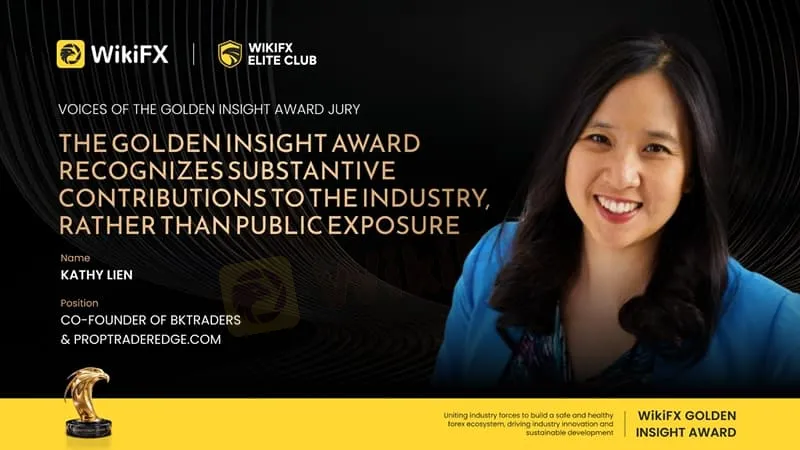
WikiFX Golden Insight Award uniting industry forces to build a safe and healthy forex ecosystem, driving industry innovation and sustainable development, launches a new feature series — “Voices of the Golden Insight Awards Jury.” Through in-depth conversations with distinguished judges, this series explores the evolving landscape of the forex industry and the shared mission to promote innovation, ethics, and sustainability.
This interview features Kathy Lien, Co-Founder of BKTraders & PropTraderEdge.com. She is the foreign exchange expert and the educator. She graduated New York University Stern School of Business and started working on Wall Street at the age of 18.
As the CNBC Contributor and Internationally Published Author of Best Selling Forex Trading Books, she is also frequently quoted in the Wall Street Journal, Financial Times, Reuters, Bloomberg, Marketwatch, Associated Press, AAP, UK Telegraph, Sydney Morning Herald and other leading news publications. Appears regularly on CNBC and Sky Business.
Part1: Sustainability Development of the Forex Industry
Q1: You founded DailyFX.com to provide analytical support for traders. In todays landscape of information overload and inconsistent quality, what key advancements have forex-focused media achieved in enhancing market transparency, trader risk awareness, and trading safety education?
A: When DailyFX was founded, one of the biggest gaps in the industry was access, a timely, credible analysis to help traders understand why markets were moving, not just why, what was moving. Since then, Forex Media has made meaningful progress in a number of areas. First, there's been a major improvement in speed and accessibility, real time data, economic challenges and instant analysis around major events to help traders prepare better understand volatility and understand risk rather than react blindly after the fact. Second, risk of awareness has become more central to the conversation. Today, responsible media is far more likely to discuss position sizing, leverage drawdowns and the psychological side of trading instead of focusing solely on trade ideas or returns. That said, the most important advancement I've seen has been in education around trading safety.
Many outlets now, they emphasize the risk of overleveraging, having unrealistic expectations, speculating too much and helping triggers recognize that survival and consistency is really what really matters. While information overload remains a challenge, the better forex media shifted towards context explanation and risk framing, and that has made the industry meaningfully safer and more transparent than it was in the past.
Q2:In your book Millionaire Traders, you examine how ordinary individuals can succeed. What core qualities should a healthy trading ecosystem develop in traders? How can industry players — brokers, educators, and media—work together to foster a culture of rationality and risk awareness, rather than promoting “get-rich-quick” narratives?
A: One of the key lessons for millionaire traders is that long term success really comes to extraordinary talent or aggressive risk taken. It comes from discipline, patient's adaptability and realistic understanding of risk. And healthy trading ecosystem should help traders develop those traits early, especially the ability to think probabistically, manage losses and stay emotionally neutral during the wins and drawdowns. Now industry players have played a role in reinforcing this mindset. We have brokers who've designed platforms and incentives rather than encourage responsible behavior, rather than excessive leverage or over trading. When brokers, educators and media align around these principles, the industry naturally moves away from the get rich quick mentality and towards a culture that values sustainability, professionalism and long term skill development.
Q3:Transparent trading, fair competition, and truthful information disclosure form the foundation of a compliant ecosystem. In which area do you think forex media most needs to improve?
A: Transparent trading, fair competition and truthful information disclosure form the foundation of a compliant ecosystem. That's what I think.Now, in terms of which area do you think, do I think that forex media could improve while the trading community is increasingly turning to social media as a trusted source of information which you know is present is positive and negatives and traditional folks, media really understand why this happening triggers the value, speed, diversity and perspectives and peer experience. This means forex media needs to evolve beyond simply covering the topics and instead really deliver what readers cannot find easily elsewhere. They need to lean on their credibility. Too much coverage remains promotional or surface level, and reporting what is happening without offering analysis that truly informs or challenges the audience. Media outlets should engage in a broader range of sources, conduct more detailed interviews and invest in deeper research with both industry and insiders and independent voices. This is what people are read and those sort of do not have access to and a really thirsting for. So rather than trying to compete with these influencer driven narratives, forex media should complement them to fact based reporting and verification, confirming, challenging, contextualizing what traders are seeing online. And one of the most valuable contributions I think media can make is to use data publishing statistics, running studies, doing polls and analyzing industry trends to provide objective insight and to build trust.
Q4:“Transparency” is regarded as a core element of a healthy financial ecosystem. How do you believe media can promote higher levels of information disclosure and healthy competition?
A: Transparency is guarded at a core element of a healthy financial ecosystem, and this is very important. And in terms of how do I believe media can promote higher levels information disclosure and healthy competition, media can promote transparency by establishing consistent standards for evaluation comparison. When the media highlights firms demonstrate integrity, risk control and long term commitment for traders, it fosters competition based on quality rather than hype.
Part II: About the WikiFX Golden Insight Award – Shaping Industry Standards and the Future
Q1: Given that there are already numerous awards within the industry, what do you think is the biggest difference between the “WikiFX Golden Insight Award” and other awards? What was it about the Golden Insight Award that made you want to become one of the expert judges?
A: One of the biggest differences between the WikiFX Golden Insight Award and many other industry awards is the emphasis on independent judgment. Too often, I've seen awards in this space be closely tied to sponsorships. Marketing partnerships are brand visibility, which would blur the line between recognition and promotion. And what stood out to me about the Golden Insight Award was its commitment to having experienced, independent judges of myself who evaluate participants based on substance rather than exposure.
That independence gives the award real credibility and makes it more meaningful for traders to try and distinguish quality from noise, and it is with this focus on objective valuation that may be interested in participating as a judge.
Q2: In your view, can the “WikiFX Golden Insight Award” enhance transparency and credibility in the forex industry, thereby safeguarding investors?
A: Yes, the WikiFX Golden Insight Award can certainly enhance transparency and credibility. When the awards are based on objective criteria and evaluated by industry experts rather than influenced by sponsorship, they provide a reliable reference for traders and investors navigating what is a very crowded and oftentimes confusing marketplace. So by engaging independent judges of myself, the award further reduces bias and strengthens its overall credibility.
Q3: How do you see the WikiFX Golden Insight Award shaping the future of a healthier forex industry?
A: Yes, I think it plays a very important role. The forex space is incredibly noisy and not all information is created equal. An award like the Golden Insight Award helps cut through that noise by drawing attention to people who are doing things the right way instead of forcing traders to rely solely on marketing claims or online chatter. It gives them a practical reference points when making decisions. So I think it's very valuable, and that visibility and guidance and credibility can help guide traders through towards safer choices, while encouraging the industry as a whole to move in a more sustainable direction.
Part3: About WikiFX — The World‘s Leading Forex Ecosystem Service Platform
Q4: What role do you think WikiFX’s products and services play in enhancing industry transparency and standardization?
A: WikiFX plays a very important role by making information more accessible and easier to compare. One of the biggest challenges in forex, I think, is fragmentation. There's different regulations, licenses and business practices that vary widely across regions, and that makes it very difficult for us to know what they're dealing with. A lot of times these brokers did very little comparison. So by consolidating regulatory data, broker profiles and user reported information in one place, WikiFX can help bring structure to an otherwise opaque market. From a standardization perspective, its tools can create a common framework for evaluating firms, not by replacing a regulation, but by making regulatory status, operational history and risk signals more visible and understandable. I think it's also important to bring in peer reviews because that's what the market is trusting these days. But in general, you know, that kind of transparency, that doesn't eliminate risk but does help to create some sort of symmetry for traders, which is one of the biggest problems that they face.
About the Golden Insight Award
As the worlds prominent forex ecosystem service platform, WikiFX has been deeply rooted in the industry for over a decade and has become a technology-driven leader in forex investment security. To recognize the efforts of forex professionals in building a healthier industry ecosystem, we are proud to present the “WikiFX Golden Insight Award.”
The Award unite regulatory bodies, brokers, IBs, KOLs, industry media, service providers, and other forex industry professionals to jointly foster a global healthy forex ecosystem and recognize industry elites for their outstanding contributions.
Uniting industry forces to build a safe and healthy forex ecosystem. Together, let's foster a more transparent, secure, and sustainable forex industry. Visit the WikiFX Insight Awards website for more information:https://www.goldeninsightaward.com/
Read more
Cabana Capital Review: Traders Report Withdrawal Issues & Account Blocks
Cabana Capital, a Saint Vincent and the Grenadines-based forex broker, has grabbed headlines for negative reasons. These include numerous complaints traders have made over withdrawal denials/delays and account blocks upon repeated attempts to contact the broker. These alleged trading activities have inevitably frustrated traders who have rightly criticized the broker online. In this Cabana Capital review article, we have mentioned a growing list of complaints against the forex broker. Keep reading!
GLOBAL GOLD & CURRENCY CORPORATION Exposure: User Complaints on Heavy Slippage & Spreads
Did you face massive slippage on the GLOBAL GOLD & CURRENCY CORPORATION trading platform and the subsequent reduction in profits? Did the broker apply a stop-loss when you were in profit? Does the high spread only add to your trading losses? Has the broker blocked your trading account and run away with your funds? You are not alone! Many traders have highlighted their painful trading experiences with the Saint Lucia-based forex broker. In this GLOBAL GOLD & CURRENCY CORPORATION review article, we have explained some of them. Read on!
Vida Markets Review: Are Traders Facing Fund Scams & Heavy Price Manipulation?
Have you witnessed illegitimate profit cancellation by Vida Markets, an Anguilla-based forex broker? Did you encounter trading losses due to inappropriate automatic stops by the broker? Were your trades closed minutes after the price changed in your favor? Did your forex trading account get blocked despite submitting the required KYC documents? Failed to get your deposit reflected in your account? These are more than just issues; they are alleged forex scams that have hit many traders. Some of them have highlighted these bad experiences while sharing the Vida Markets review. In this article, we have shared some of them. Keep reading!
LTI Legitimacy Check: Is This a Fake Broker or a Legitimate Trading Partner?
If you're wondering "Is LTI legit?" or worried about a possible "LTI scam," you're asking smart questions. Being careful is the most important skill a trader can have. To save your time, we will give you our answer right away: after carefully checking its legal status, company information, and how it operates, London Trading Index (LTI) shows serious warning signs that any potential trader needs to know about. The dangers are real and well-documented. This article won't be based on opinions. We'll show you the proof step by step, focusing on facts you can check yourself. We'll examine official warnings, look at the broker's information, and study its trading rules. By the end, you'll have a clear picture based on evidence, helping you make a smart and safe choice for your capital.
WikiFX Broker
Latest News
Gold Breaches $5,100 as 'De-Dollarization' and Tariff Wars Crush the Greenback
WikiFXGold Breaches $5,100 as 'De-Dollarization' and Tariff Wars Crush the Greenback
WikiFXAPAC Outlook: 'Takaichi Trade' Returns to Tokyo; RBA Hike Bets Propel Aussie Dollar
WikiFXDollar Index Falters Near 97.00 as Washington Dysfunction Overshadows Economic Data
WikiFXGold Breaches $5,100 as 'De-Dollarization' and Tariff Wars Crush the Greenback
WikiFXGeopolitical Risk Premium Rising: Russia Warns on Arms Treaty as Trump Pushes Ukraine Land Deal
WikiFXDollar Index Falters Near 97.00 as Washington Dysfunction Overshadows Economic Data
WikiFXIs ICM Brokers Legit? Checking Its Legitimacy and Scam Risks
WikiFXGeopolitical Risk Premium Rising: Russia Warns on Arms Treaty as Trump Pushes Ukraine Land Deal
WikiFXUS Crisis Deepens: Government Shutdown Odds Hit 78% Amid Winter Paralysis and Fed Feud
WikiFXRate Calc
